Back
Back
Berky the Worm
How We Turned Berkeley’s Composting Crisis into a Community Playground
Role
Lead UI Designer
Team
Berkeley MDes
Timeline
4 Weeks, Fall 2025
Skills
Physical-Digital Design, UI Design, Public Infrastructure, Sustainability
Impact
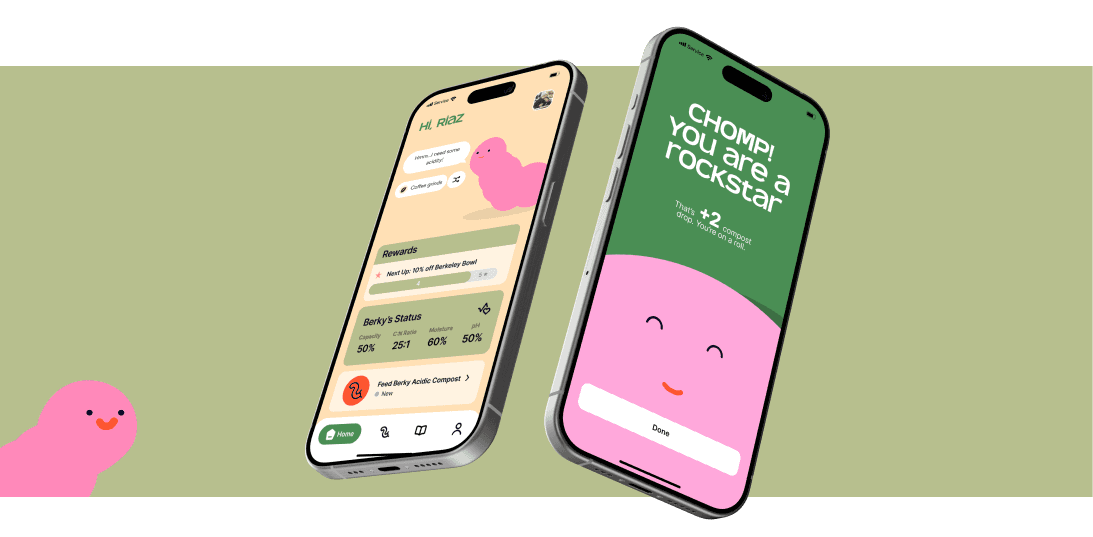
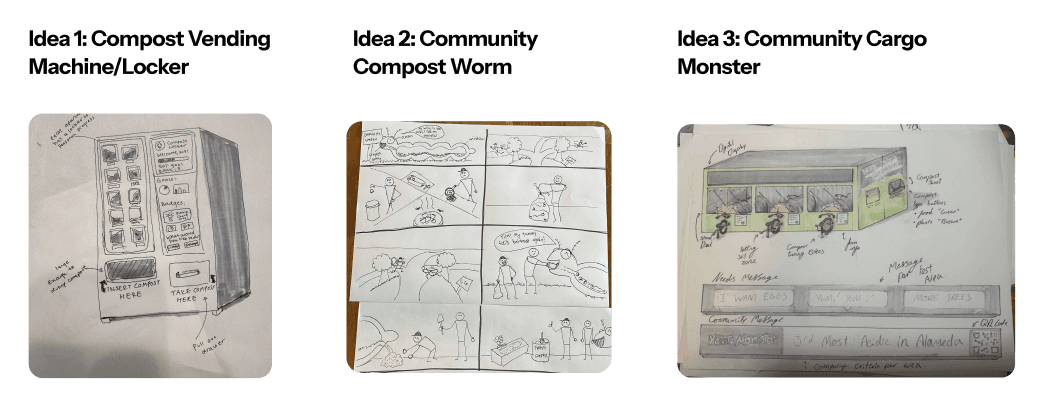
Berky the Worm is a service design initiative aimed at making composting a fun, habitual part of life for the Berkeley community. By blending physical play structures with a digital reward system, we transformed a "gross" chore into an art-integrated social experience. My role as UI lead was to contribute heavily to initial idea generation and ideation, as well as design the high fidelity app design.
In the future, we would aim to track success through a Target 150+ weekly active users participating in the reward ecosystem, as well as 500 lbs of organic waste diverted per week, measured through engagement tracking and local community management.
Challenge
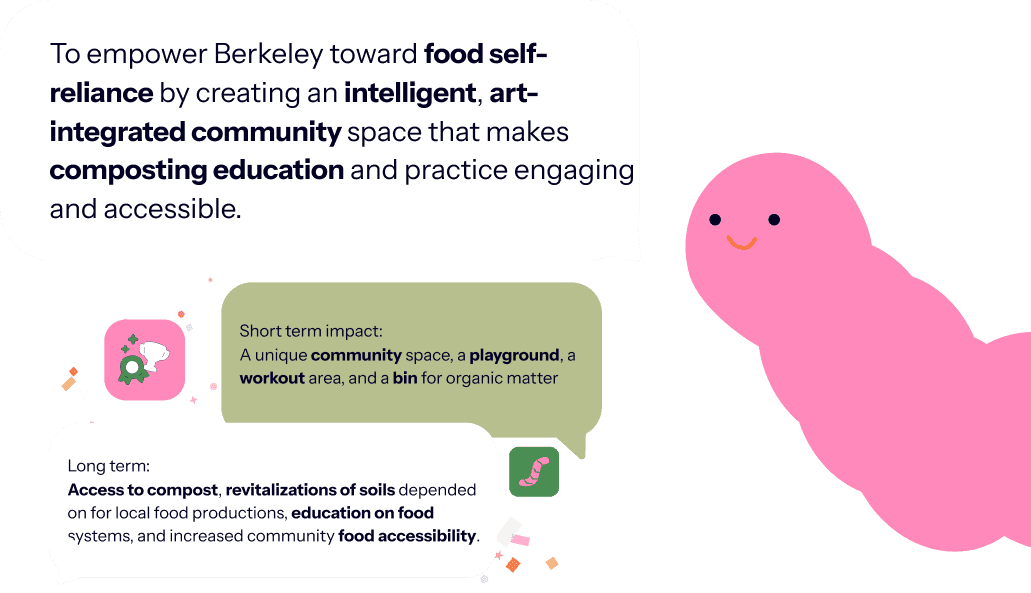
Composting isn’t failing because people don’t care about sustainability. It’s failing because the current experience doesn’t work for them.
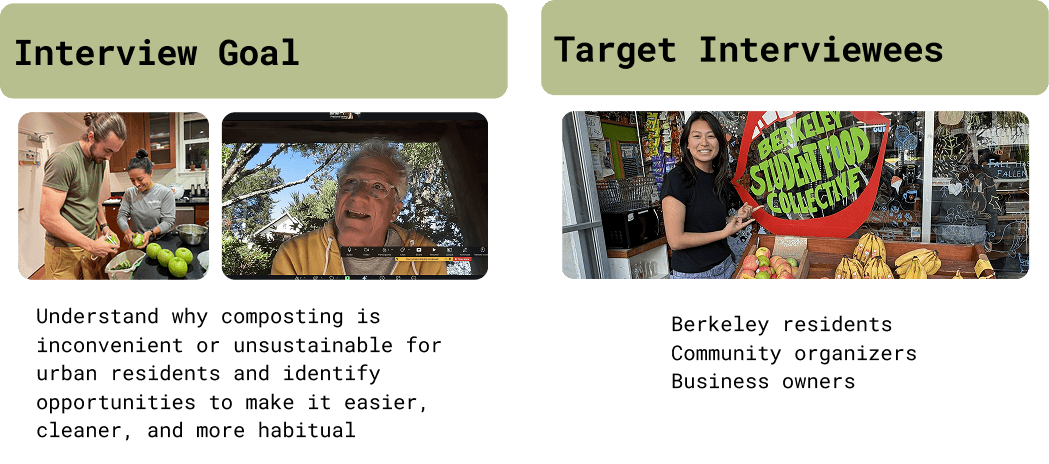
Berkeley generates tons of organic waste daily, yet residents consistently fail to compost. Our initial research consisted of 8 interviews with 6 residents and 2 experts.
"Maybe it would motivate me if I knew more of the impact I was making by composting, or if it could be more fun/less gross somehow.”
Process
From our research, we mapped out three core reasons why people stop composting before they start.
The "Gross" Factor: Indoor bins are perceived as unhygienic, attracting pests and bad smells.
The Effort Gap: Manual waste sorting is viewed as a tedious process requiring more effort than standard recycling.
The Knowledge Void: Residents often don't know where their waste goes or how to manage it if their building doesn't participate.
Our Hypothesis:
If composting systems are redesigned to be more intuitive, accessible, and personally rewarding, users will be more likely to adopt and sustain composting behaviors, reducing organic waste sent to landfills.
Outcome
Built for Play - part art, part playground.
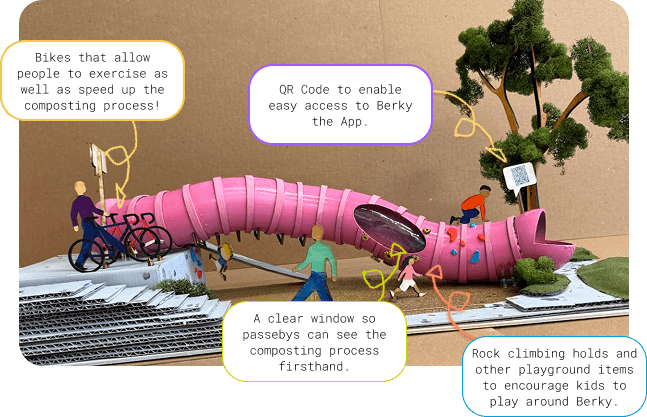
Berky functions as a playground for kids, a hangout for adults, and a composting drop-off. However, the play is not just “fun” - it provides access to finished compost, revitalizes local soils, educates the community on food systems, and increases food accessibility.
Gamify Gamify Gamify: A Digital Care Companion.
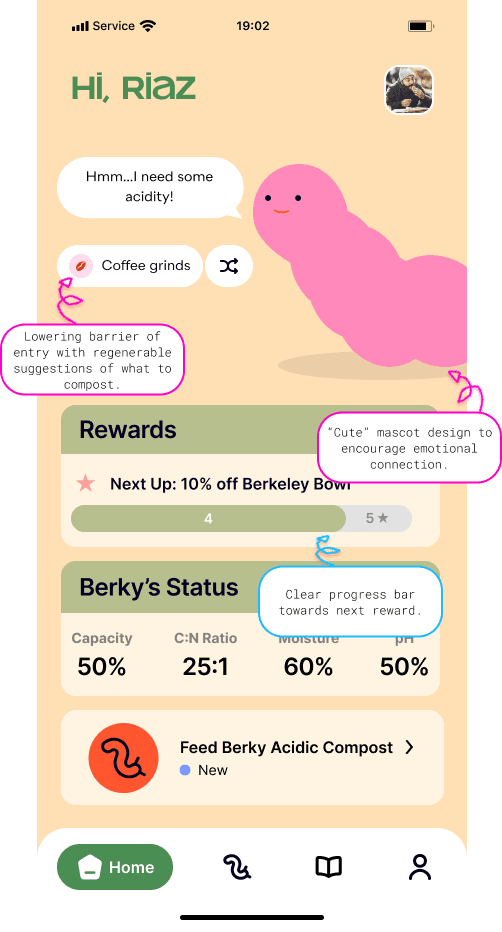
Berky is paired with a companion app that extends engagement beyond the physical site. Users can track Berky's health status, see what organic material is needed, monitor the composting progress, and earn rewards redeemable at local grocery stores. Push notifications prompt users when Berky is hungry.
We also chose a playful, modern aesthetic for the app, designing Berky’s digital counterpart as a cute illustrated worm to inspire personal attachment and connection to our users even beyond the playground.
Reflection
Composting is traditionally viewed as a tedious, manual chore. My goal was to flip that script by introducing incentivized loops. By designing a reward system where users earn coupons for local grocery stores, we turned organic waste into a digital currency. I learned that UI can be the ultimate motivator for unappealing real-world tasks.
Back
Berky the Worm
How We Turned Berkeley’s Composting Crisis into a Community Playground
Role
Lead UI Designer
Team
Berkeley MDes
Timeline
4 Weeks, Fall 2025
Skills
Physical-Digital Design, UI Design, Public Infrastructure, Sustainability
Impact
Berky the Worm is a service design initiative aimed at making composting a fun, habitual part of life for the Berkeley community. By blending physical play structures with a digital reward system, we transformed a "gross" chore into an art-integrated social experience. My role as UI lead was to contribute heavily to initial idea generation and ideation, as well as design the high fidelity app design.
In the future, we would aim to track success through a Target 150+ weekly active users participating in the reward ecosystem, as well as 500 lbs of organic waste diverted per week, measured through engagement tracking and local community management.
Challenge
Composting isn’t failing because people don’t care about sustainability. It’s failing because the current experience doesn’t work for them.
Berkeley generates tons of organic waste daily, yet residents consistently fail to compost. Our initial research consisted of 8 interviews with 6 residents and 2 experts.
"Maybe it would motivate me if I knew more of the impact I was making by composting, or if it could be more fun/less gross somehow.”
Process
From our research, we mapped out three core reasons why people stop composting before they start.
The "Gross" Factor: Indoor bins are perceived as unhygienic, attracting pests and bad smells.
The Effort Gap: Manual waste sorting is viewed as a tedious process requiring more effort than standard recycling.
The Knowledge Void: Residents often don't know where their waste goes or how to manage it if their building doesn't participate.
Our Hypothesis:
If composting systems are redesigned to be more intuitive, accessible, and personally rewarding, users will be more likely to adopt and sustain composting behaviors, reducing organic waste sent to landfills.
Outcome
Built for Play - part art, part playground.
Berky functions as a playground for kids, a hangout for adults, and a composting drop-off. However, the play is not just “fun” - it provides access to finished compost, revitalizes local soils, educates the community on food systems, and increases food accessibility.
Gamify Gamify Gamify: A Digital Care Companion.
Berky is paired with a companion app that extends engagement beyond the physical site. Users can track Berky's health status, see what organic material is needed, monitor the composting progress, and earn rewards redeemable at local grocery stores. Push notifications prompt users when Berky is hungry.
We also chose a playful, modern aesthetic for the app, designing Berky’s digital counterpart as a cute illustrated worm to inspire personal attachment and connection to our users even beyond the playground.
Reflection
Composting is traditionally viewed as a tedious, manual chore. My goal was to flip that script by introducing incentivized loops. By designing a reward system where users earn coupons for local grocery stores, we turned organic waste into a digital currency. I learned that UI can be the ultimate motivator for unappealing real-world tasks.