Back
Back
Cocoon (Series A Startup B2B)
Leading the design of an In-Product Compliant Pregnancy Leave Tracker as lead designer and engineer
Role
Product Designer & Full-stack Engineer
Team
Cocoon’s Core Leave & Pay Team (Healthcare · B2B)
Timeline
6 Weeks, May-June 2024
Skills
Product Engineering, XFN Interviews, UI Design
Impact
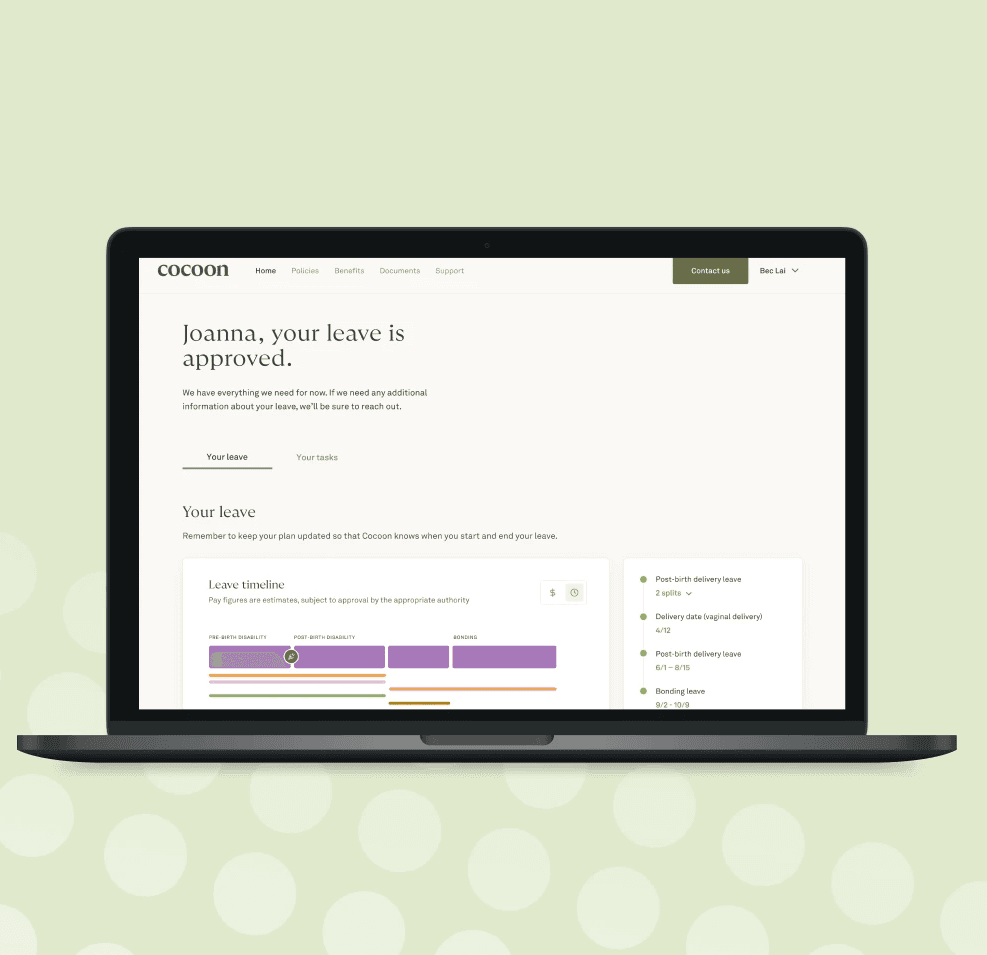
As a full-stack engineer at this startup, I had the unique opportunity to take over as a product designer when our team designer was out. I lead the project from scoping to Figma design for our first milestone to create a pregnancy disability leave tracker, as well as led the engineering efforts behind it.
Goal Impact:
Enable new leave types for 1K+ users.
Lower Operations Overhead by decreasing time spent on Americans with Disabilities Act (ADA) leaves by 50%.
Challenge
Cocoon is a leave management software that automates the complexities of compliance, claims, and payroll for People teams and their employees.
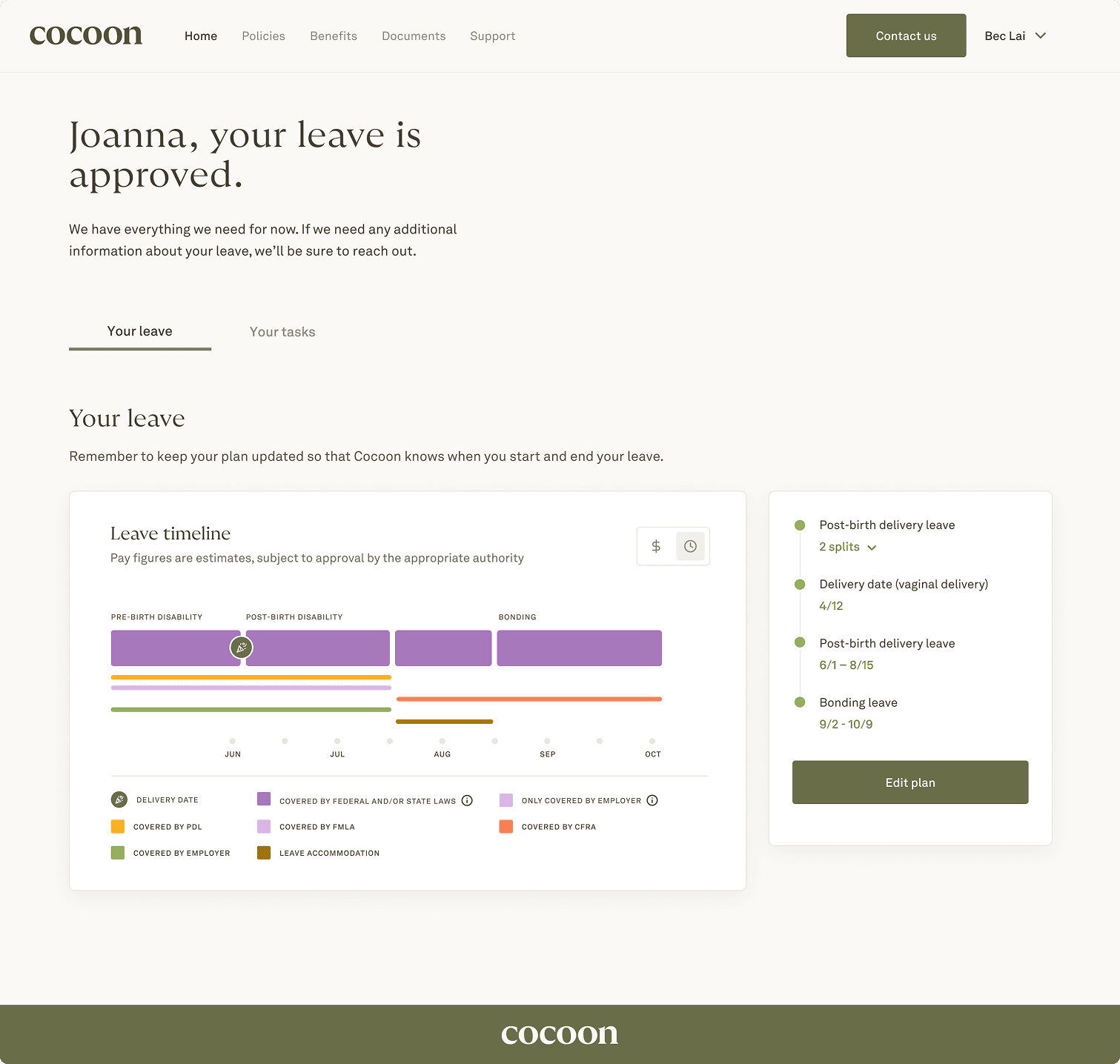
The product codifies federal and state laws to calculate each employee’s eligibility and automate designation notices, and enables users to privately plan a leave in minutes, easily file claims, and accurately track their pay.
Pregnancy disability leave (PDL) is one of the leaves that Cocoon covers. However, there are several nuances to keep the leave compliant, as well as be compatible with the way Cocoon’s system handles leaves.
Some images will be blurred for privacy reasons!
Process
With the product gaps in mind, I conducted a brainstorming session with our internal stakeholders - our engineering team, the marketing lead, operations lead, and our legal team.
The stakeholder interviews uncovered existing system had gaps in handling compliance, SHC forms, and flexible approvals for extended leaves. I determined that specific challenges included:
Ambiguity around when SHC forms were required.
Lack of clarity on the employer's role in approving extended leave and pay.
Compliance risks tied to insufficient or delayed SHC handling.
Auto-approval of parental disability leave without SHC documentation.
Employee’s leave dates ranges are limited in our current leave designer U.I
Outcome
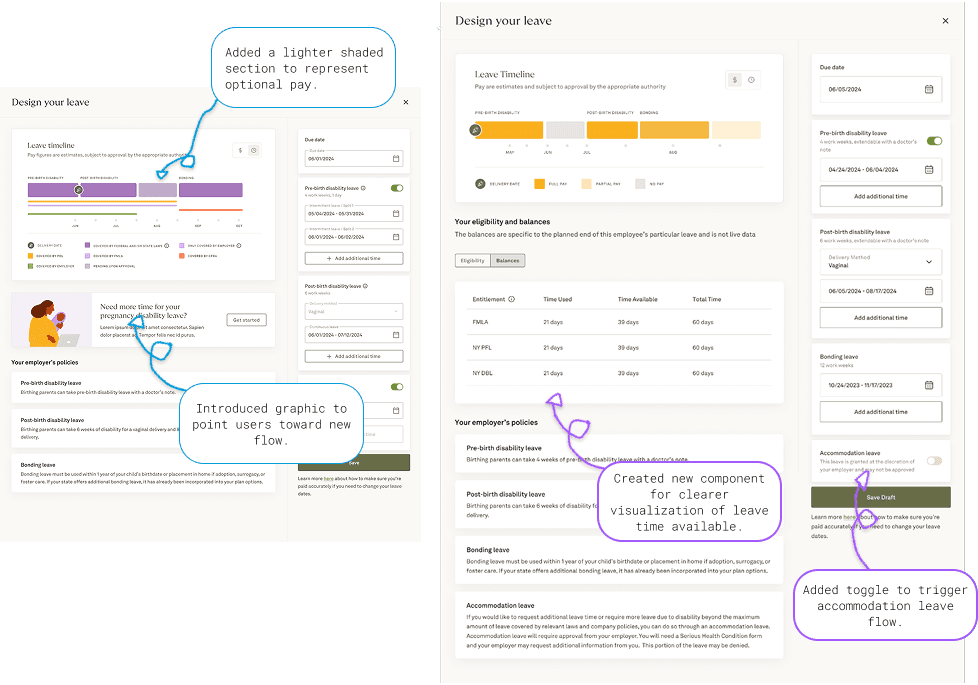
After discussing with other engineers, we narrowed down the flow to 3 main milestones with detailed acceptance criteria. I was able to complete the final high fidelity version for our first milestone. The goal of this milestone was to allow users to extend pre/post birth disability with existing entitlement.
Design Rationale
Minimal Engineering Overhead & Multiple User Entry Points
When designing the net new components, I tried to reuse as many tokens as possible. I also decided to use JSON Forms as the basis of the new forms and wrapping them in Cocoon theme colors rather than designing new elements from scratch since we already had it as a dependency.
It was important to our stakeholders that users were able to enter the new flow at multiple points, as not every user would know they required pregnancy disability leave as a subset of their parental leave. This meant adding clear explanations that were toggle-able to not overwhelm users with an abundance of information.
Reflection
I was really happy to be given the opportunity to work as a product designer on our startup team. It was definitely a challenge to balance my engineering commitments while also taking on the role of designer - time management really saved me.
This was my first time really getting into the weeds of what we did at Cocoon - learning the landscape took way longer than I had originally budgeted for. I was proactive in asking questions and made sure I had a solid understanding of everything before proceeding. It was a lesson learned to always give some wiggle-room for projected timelines.
Design is really the bridge between our product, our users and our engineering team. I learned to make design decisions while taking into account the trade offs from so many perspectives: business, engineering, and user experience.
Back
Cocoon (Series A Startup B2B)
Leading the design of an In-Product Compliant Pregnancy Leave Tracker as lead designer and engineer
Role
Product Designer & Full-stack Engineer
Team
Cocoon’s Core Leave & Pay Team (Healthcare · B2B)
Timeline
6 Weeks, May-June 2024
Skills
Product Engineering, XFN Interviews, UI Design
Impact
As a full-stack engineer at this startup, I had the unique opportunity to take over as a product designer when our team designer was out. I lead the project from scoping to Figma design for our first milestone to create a pregnancy disability leave tracker, as well as led the engineering efforts behind it.
Goal Impact:
Enable new leave types for 1K+ users.
Lower Operations Overhead by decreasing time spent on Americans with Disabilities Act (ADA) leaves by 50%.
Challenge
Cocoon is a leave management software that automates the complexities of compliance, claims, and payroll for People teams and their employees.
The product codifies federal and state laws to calculate each employee’s eligibility and automate designation notices, and enables users to privately plan a leave in minutes, easily file claims, and accurately track their pay.
Pregnancy disability leave (PDL) is one of the leaves that Cocoon covers. However, there are several nuances to keep the leave compliant, as well as be compatible with the way Cocoon’s system handles leaves.
Some images will be blurred for privacy reasons!
Process
With the product gaps in mind, I conducted a brainstorming session with our internal stakeholders - our engineering team, the marketing lead, operations lead, and our legal team.
The stakeholder interviews uncovered existing system had gaps in handling compliance, SHC forms, and flexible approvals for extended leaves. I determined that specific challenges included:
Ambiguity around when SHC forms were required.
Lack of clarity on the employer's role in approving extended leave and pay.
Compliance risks tied to insufficient or delayed SHC handling.
Auto-approval of parental disability leave without SHC documentation.
Employee’s leave dates ranges are limited in our current leave designer U.I
Outcome
After discussing with other engineers, we narrowed down the flow to 3 main milestones with detailed acceptance criteria. I was able to complete the final high fidelity version for our first milestone. The goal of this milestone was to allow users to extend pre/post birth disability with existing entitlement.
Design Rationale
Minimal Engineering Overhead & Multiple User Entry Points
When designing the net new components, I tried to reuse as many tokens as possible. I also decided to use JSON Forms as the basis of the new forms and wrapping them in Cocoon theme colors rather than designing new elements from scratch since we already had it as a dependency.
It was important to our stakeholders that users were able to enter the new flow at multiple points, as not every user would know they required pregnancy disability leave as a subset of their parental leave. This meant adding clear explanations that were toggle-able to not overwhelm users with an abundance of information.
Reflection
I was really happy to be given the opportunity to work as a product designer on our startup team. It was definitely a challenge to balance my engineering commitments while also taking on the role of designer - time management really saved me.
This was my first time really getting into the weeds of what we did at Cocoon - learning the landscape took way longer than I had originally budgeted for. I was proactive in asking questions and made sure I had a solid understanding of everything before proceeding. It was a lesson learned to always give some wiggle-room for projected timelines.
Design is really the bridge between our product, our users and our engineering team. I learned to make design decisions while taking into account the trade offs from so many perspectives: business, engineering, and user experience.